Earthquakes: A New Feature in Google Search

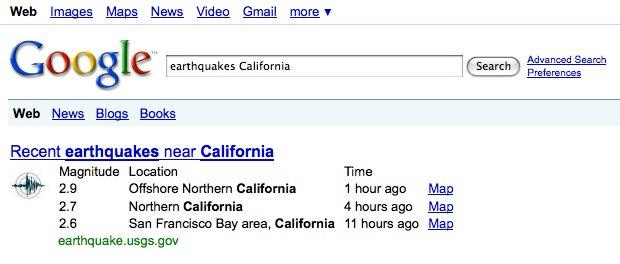
Following the news that Google is working on a tool to tackle energy consumption awareness, it has recently come to light that the Mountain View search engine giant is also taking on the challenge of providing accurate earthquake information. All you have to do is type in “earthquakes”, press Google search and you will get a OneBox result displaying the most recent earthquakes. The data displayed by Google comes from the US Geological Survey and is as accurate as it gets. The downside is that this earthquake functionality is only available if you use Google US, or if you are in actually in the US of A.
Software Engineer with the Search User Interface Team at Google, Mike Danylchuk comments: “When we in the Bay Area feel an earthquake, we want to know how strong it was and where it occurred, as soon as possible. After all, even a small vibration could be the result of a severe earthquake far away. Traditionally, we've had to wait for answers as reporters scrambled to investigate and spread the news. Now, when you search for "earthquakes" on Google, you'll get information on some of the most recent, significant earthquakes from around the world, right on the search results page. From there, you can click through to the USGS Earthquake Center for more information, or visit the epicenter of any quake on Google Maps. To find earthquakes closer to home, you can add a location to your query.”
To my mind, the feature is certainly a useful one – even if it is to satisfy your curiosity whether the tremble you just felt was an actual earthquake or just you having a really vivid dream. It is rather annoying that people in the rest of the world cannot access the feature; if you are in Europe for example and you type in “earthquake” or “earthquakes” you will not get the OneBox result you would get in Google US; which does not make a lot of sense since the results refer to “earthquakes from around the world”, not from the US alone. This is one aspect where Google search falls short compared to other search engines – Ask.com has provided the same functionality for some time now, and continues to do so with no geographical location limitations. Just head over to their web page and type in “earthquake” and you will get something like this.
Software Engineer with the Search User Interface Team at Google, Mike Danylchuk comments: “When we in the Bay Area feel an earthquake, we want to know how strong it was and where it occurred, as soon as possible. After all, even a small vibration could be the result of a severe earthquake far away. Traditionally, we've had to wait for answers as reporters scrambled to investigate and spread the news. Now, when you search for "earthquakes" on Google, you'll get information on some of the most recent, significant earthquakes from around the world, right on the search results page. From there, you can click through to the USGS Earthquake Center for more information, or visit the epicenter of any quake on Google Maps. To find earthquakes closer to home, you can add a location to your query.”
To my mind, the feature is certainly a useful one – even if it is to satisfy your curiosity whether the tremble you just felt was an actual earthquake or just you having a really vivid dream. It is rather annoying that people in the rest of the world cannot access the feature; if you are in Europe for example and you type in “earthquake” or “earthquakes” you will not get the OneBox result you would get in Google US; which does not make a lot of sense since the results refer to “earthquakes from around the world”, not from the US alone. This is one aspect where Google search falls short compared to other search engines – Ask.com has provided the same functionality for some time now, and continues to do so with no geographical location limitations. Just head over to their web page and type in “earthquake” and you will get something like this.